Designing for a Tribal Owner: What Changes, Concretely
Tribal gaming is not commercial gaming with different iconography. The archive's projects show the differences landing in ownership, delivery, brief and cultural authority — usually all four at once.
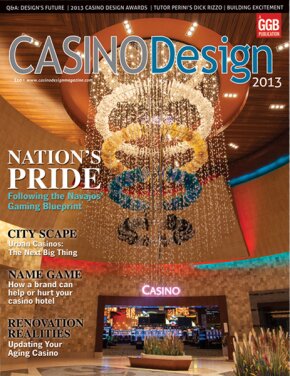
A large share of the projects in this archive are tribally owned, and the credit blocks make the difference legible in a way the photographs do not. Four things change, and they change together.
1. The client is a government
The owner lines read like nothing in commercial gaming: The Confederated Tribes of Warm Springs, represented by the Warm Springs, Wasco and Paiute tribes
(Containing Culture & Costs); Forest County Potawatomi Tribe
(Telling A Story); The Seneca Nation
(Harbor Master); Chippewa Indian Tribe of Michigan
(Aqua Fun); The Federated Indians of Graton Rancheria
(Signature Style).
The first of those is worth reading twice: three tribes, one owner, represented jointly. Design approval on that project is a governmental process with its own timetable, and it is not comparable to a corporate sign-off.
2. Operation may be contracted out — and the credit block says so
Signature Style prints owner and operator as separate lines: the Federated Indians of Graton Rancheria own; Station Casinos operate. That split shapes the brief. The operator brings floor-layout standards, food and beverage programmes and loyalty systems; the owner brings the land, the compact, the cultural content and the long horizon. Where the two disagree, the building shows it.
3. Construction is often kept in-house
The most under-reported line in tribal project credits is the contractor. Harbor Master credits Seneca Construction Management Corporation
— a nation-owned construction arm delivering a $130 million property designed by Hnedak Bobo Group, now HBG Design. Building capability, not just a building, is frequently part of the project's purpose, and it changes procurement, phasing and who holds the risk. See how to read a credit block.
4. Cultural content has an author and a rights-holder
This is the part most often misunderstood from outside. In commercial theming the reference is borrowed and unowned; here it is neither.
Building an Enterprise describes carrying a single element — the wind, a strong element in Navajo culture
— through the exterior of the property, and in chandeliers, carpet patterns and ceiling elements.
One idea, four scales, consistently applied. Telling A Story puts the content in the arrival itself: You enter a whimsical porte cochere, which is an abstract form of an eagle about to take off
— with the story careful to note that eagles are very potent symbols to almost all Indian tribes
, which is to say, the meaning is not the designer's to invent.
The practical consequence: the cultural layer is reviewed, not presented. It lives in surfaces a review can reach and a craftsperson can make — pattern, ceiling, light, landscape, art — which is why tribal projects in this archive have such strong floor and ceiling work.
The budget range is wider than people expect
The credit blocks put tribal projects across the whole spectrum: $11.2 million for the 20,000-square-foot Warm Springs property, with an 18,000-square-foot gaming floor; $34 million for the 103,000-square-foot project in Aqua Fun; $130 million at Seneca; $150 million at Potawatomi; $820 million at Graton. Anyone who thinks of tribal gaming as a single market segment is reading one end of that list.
The small end is where the archive's best cost discipline appears — Containing Culture & Costs is a title that states the whole brief. See also what a casino project cost actually includes.
What a designer should take from this
- Find out early whether an operator is in the deal, and whose standards govern the floor.
- Ask who will build it. If the owner has a construction arm, the delivery method is already decided.
- Treat cultural content as a review process with a rights-holder, scheduled like any other approval — not as a design gesture to be revealed.
- Put the content where it can be made and maintained locally. The archive's durable examples are in pattern, ceiling and landscape, not in scenery.
Related: theming didn't die, it got specific, and the rest of the archive's project reporting in Architecture.